Virtual Science Ltd
+44 1249 736656
Refraction and Reflection
Introduction
When light passes from one medium to another, it is refracted – or bent – at the boundary between the two mediums. This can be easily observed by looking at a drinking straw in a glass of water. The straw looks to be bent at the contact surface between air and water. The amount by which the light is bent is different according to a property of the medium called the refractive index. The higher the refractive index, the more that light is bent. Diamond has a very high refractive index, and it is this property that allows many facets to be ground onto a diamond, making it sparkle much more than can be achieved with glass.
The exact law of refraction is called Snell’s law of refraction, after the Dutch astronomer Willebrord Snellius (1580–1626). The law gives the relationship as:
sin(i)/sin(r) = n1/n2
Where i is the incident angle, r is the refracted angle, n1 is the refractive index of the first medium, and n2 is the refractive index of the second medium.

The objective
To demonstrate that different mediums bend light by different amounts and to confirm Snell’s law of refraction.
The apparatus
• A light box
• A collection of rectangular blocks of different transparent mediums
• Some graph paper
• A protractor
Arrange the glass block to be in the path of the light from the light box, both placed on top of a large sheet of graph paper so that the light ray is traveling along one of the axes of the graph paper.
The variables
The independent variable is the incident angle. The dependent variable is the refracted angle.
The Physics
Light is a wave that travels at c, the speed of light, in a vacuum. In any other medium, light travels at a slower speed. The refractive index of a medium is directly connected to the speed of light in that medium. Think of wavefronts of light arriving at the surface of a substance like water. As a wavefront reaches the water, it travels more slowly and so bends the light towards the normal.
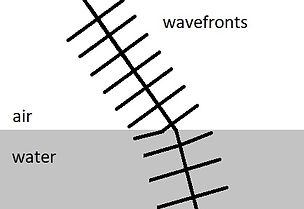
If this is difficult to imagine for a light wave, imagine that each wavefront is a line of soldiers marching towards the water’s edge at an oblique angle. As the first soldier reaches the water, he slows down, and the rest of the soldiers carry on at the same speed until the next soldier reaches the water and slows down. The overall effect is to pivot the soldiers’ direction towards the normal. Snell’s law can be restated as:
sin(i)/sin(r) = v1/v2
Where i is the incident angle; r is the refracted angle, as before; v1 is the speed of light in the first medium; and v2 is the speed of light in the second medium. This can be derived in a variety of ways. However, the geometric construction based on the earlier observation is very simple. Consider a light front arriving so that the left part just reaches the second medium at point A, as shown here:

At some time, dt later, the right-hand part of the wavefront reaches the medium. Then:
AC = v2dt
BD = V1Dt
Simple geometry tells us that the angle ADC = r, and the angle BAD = i. Therefore, considering the right-angled triangles ADC and BAD:
sin(i) = V1dt
sin(r) = V2dt
From which the law can be directly derived.
The method
For demonstrating that different substances bend light by different amounts, simply use the protractor to measure these angles.
To verify Snell’s law, proceed as follows. Set the incident angle for the light ray to 20 degrees. You can do this by having the glass block on graph paper and aligning the paper with the beam of light. Then, by putting the protractor up to the edge of the block as shown in Figure 31.4, you can measure the incident angle by looking at the line (vertical in the picture) from the center of the protractor to its edge. The picture below shows this angle being set to 30 degrees; this is the incident angle, i.

You can either use a protractor directly to measure the refracted angle or use a pencil to mark the entry and exit points of the ray on the graph paper, then remove the block and create the line joining the points you have just made, and then measure the angle with the protractor. This is the refracted angle, r. Repeat this for a range of angles, noting the incident angle and the refracted angle for each case.
The Video
Watch a video of the Refraction and Reflection e-practical here.
This shows how to use it and how to collect the data.
The e-Practical
Perform the experiment yourself, collect your own data, make mistakes and be able to correct them. The e-practical requires that your browser canrun WebGL 2 (usually found on Windows browsers, safari on iOS, and various Mobile browsers, test with https://get.webgl.org/webgl2/). This link is for students and evaluation only, schools should purchase a site licence.
The e-practical will run on laptops and desktops for PCs and Apple computers and will run on mid to high spec tablets and 'phones. All the e-practicals will run on devices as small as a mobile 'phone. However, the best experience is on a PC using a mouse which gives very precise control, but if you are limited to a small device, consider using a stylus or a blue tooth mouse.
On a portable device, make sure you click on 'Toggle onscreen controls'. The left joystick controls movement, the right joystick controls direction and where you are looking.
This e-practical is a little different from all the others, as you have an overhead view and cannot move around all of the laboratory. You can move a restricted amount by using the cursor keys or the onscreen left joystick control. You will find it useful to use the magnifier to get up close to the block and protractor to take accurate measurements of the incident and refracted angles.
Each block can be selected by clicking on it; the block will then be moved to the graph paper immediately in front of the light box. The blocks, once in place, can be rotated either by using the mouse wheel or by dragging when using the onscreen controls.
You can position the protractor by dragging it; it can be rotated using the mouse wheel or the right-hand joystick when using the onscreen controls.
The Results
Create a table of your results and calculate the sin(i)/sin(r) value. Compare this with the known values for the refractive indices of the various transparent materials.

Further Discussion
Not all the light from the beam is refracted, there will usually be some light that is reflected as you can see below. Confirm that the angle of incidence is always equal to the angle of reflection by measuring these for different angles using different blocks.
Total internal reflection occurs when the light ray inside the material such as glass is completely reflected internally.

Here you can see the refracted ray just skimming the top of the semicircular glass block, while the reflected ray behaves normally, with its incident and reflected angle the same. This is principal property of reflection. You can use the e-practical to confirm it by creating a table of incident and reflected angles. The angles can be measured using a simple protractor as shown above.
Using the semicircular block, find the angle at which there is total internal reflection. This is called the critical angle, and it is marked by c in the figure below.

From Snell’s law applied to Figure 31.3, we get:
sin (90)/sin(c) = n (the refractive index)
n = 1/sin(c)
Verify that this formula is consistent with the value you measured.
Exam Questions
AQA June 25 Foundation Paper 2

If you have any problems with this then make sure you try the e-practical.


The angles are the same, so it must be a proportional correlation of the form:
A = kB
This is the standard equation for a proportional correlation. When A is plotted against B it always yields a straight line. 'k' is the constant of proportionality, and in this case, k = 1.
This section is adapted from material developed by Dr Robert Lucas and is related to the book High School and Undergraduate Physics Practicals, published by CRC Press.