
Virtual Science Ltd
+44 1249 736656
Hooke's Law - GCSE Physics Required Practical
Introduction
Robert Hooke was a contemporary of Isaac Newton, Christopher Wren and Robert Boyle, he actually made the vacuum pumps for Boyle’s experiments with gases. He achieved in many scientific areas mainly as the curator for experiments at the Royal Society, but he was also the Surveyor to the City of London and performed many of the surveys necessary after the great fire of London. The law that bears his name and concerns the relationship between the force on an elastic substance and its extension was discovered by Hooke in 1660 although not published until some eighteen years later. He put the result into practice by inventing the hairspring; a device that made the portable time piece or pocket watch possible.
When we apply a force to stretch something and on letting go it returns to its original size and shape, we say that the object has undergone an elastic deformation. These are the kind of deformations that we are concerned with here. When we stretch with some force elastic or a steel wire it will stretch and intuitively we are aware that the bigger the force the more it will stretch. We are also aware that some materials stretch more than others. What exactly is the relationship between the force and the amount something stretches for a particular material? That’s the question that we are going to answer with this experiment.
Hooke’s Law which states that the amount a substance stretches when a force is applied to it is proportional to the force.
When we apply some force an elastic or a steel wire it will stretch and intuitively, we are aware that the bigger the force the more it will stretch, that is the extension is proportional to the force. This can be expressed as:
F = k e
Where F is the force, e is the extension and k is known as the spring constant. The formula is simply saying that the stretch amount is proportional to the force. That is the bigger the force the more the substance stretches.
The stretchiness is the spring constant. The larger the spring constant the stiffer the stretchiness.
The objective
To show that the amount that an elastic wire stretches (the extension) is proportional to the force applied.
This means it should obey the law:
F = k e

The apparatus
·A ruler;
·A protractor;
·A thin steel wire (a top E guitar string works well);
·A set of weights;
·A weight support;
·Two G-clamps;
·An axle with pulley and indicator;
·Axle supporting block;
·A wood block.
The thin wire is held at one end between a block of wood and a G-clamp. For extra firmness it can be looped and pinned to the left of the G-clamp as shown here. The pulley has a green pointer attached whose angle can be measured from the protractor behind it.


The variables
The independent variable is the weight, and the dependent variable is the angle.
This means that within the experiment, it is the weight or force on the wire that we will control and it is the angle of the pointer that we will measure and record.
In the picture, it is the weight in the cradle that is changed and the pointer is expected to turn clockwise as weight is added.
The Physics
It is especially useful to express the angle in radians rather than degrees. Radians are a unit of angle frequently used in Mathematics and Physics as it often makes calculations and equations simpler.
To convert Theta (or ϴ) degrees to radians you can multiply by 2п /360. Your calculator may have an immediate way of doing this.
To calculate the extension, delta e use the formula:
Δe = ϴ x radius of the wire
The method
We add just enough weight to the cradle to make the wire just tense, i.e. no kinks. Note the position of the pointer against the protractor and the weight. Now add weights and for every different weight note the pointer position.

By far the easiest way of doing this is to use a spreadsheet program like Excel, then all the calculations can be done for you except for the first in each column and it is only necessary to add the recorded data in the first two columns. if you want to know how to do this then click here.
So, either using a spreadsheet or a pen and paper, complete the table above. When complete plot a graph showing the force against extension and verify that this is a straight line. This demonstrates that the extension is proportional to the force.
Now calculate the stiffness constant, k, using the formula given at the start (F = k e).
The Video
Watch a video of the Hooke's Law e-practical here.
This shows how to use it and how to collect the data.
The E-Practical
Perform the experiment yourself, collect your own data, make mistakes and be able to correct them. The e-practical requires that your browser can run WebGL 2 (usually found on Windows browsers, safari on iOS, and various Mobile browsers, test with https://get.webgl.org/webgl2/). This link is for students and evaluation only, schools should purchase a site licence. All the e-practicals will run on devices as small as a mobile 'phone. However, the best experience is on a PC using a mouse which gives very precise control, but if you are limited to a small device, consider using a stylus or a blue tooth mouse.
In the e-practical, we are assuming that the cradle is supplying sufficient force to minimally extend the wire. We are taking this as the zero point for the force and the extension. It is at this cradle-weight that we are measuring the angle from.
The weights in the cradle can be altered by placing the mouse cursor over the cradle and clicking.
Elastic and inelastic deformations
Where the substance obeys Hooke's Law, i.e. where the relationship between force and extension obeys Hooke's Law, we say that the material is elastic. However, it is possible to carry on increasing the force until this relationship breaks down. For a wire, this would be the point where the wire itself is being damaged, i.e. by becoming thinner. When the force is removed, it will no longer go back to its original length. This emphasises a key property of an elastic deformation. An elastic deformation will always return to its original size/shape when the force is stopped. This is not the case for an inelastic deformation.
If we plotted force against extension for a steel wire like the one we have used in the e-practical then if we kept increasing the force beyond the elastic limit (where Hooke's Law applies) we would get this:


This shows us where the inelastic deformation starts, it is where the straight line ends.
Energy stored in the stretched wire
The energy stored in a stretched wire is given by the formula:
E = 0.5 k e²
This is identical to the work done on the wire in stretching it to this extension as, of course, it must be due to conservation of energy. You can justify the expression by noting that work done is force x distance. The force can be averaged over the entire distance e, as k 0.5e, then this needs to be multiplied by the distance which is e. This gives the above formula.
Calculate the energy stored in the wire for the largest weight you used in your experiment.
Sources of inaccuracy
-
Measuring the position of the needle against the protractor. Parallax effects should be minimised by positioning your eye right in front of the needle and scale. The position of the pointer is amplified by wrapping the wire around a spindle, so this is quite optimal. The experiment is often done with the extension measured directly against a ruler, this introduces a considerable error in measurement given that the amount of stretch is quite small. However, using a spring instead of a wire makes the extension much greater and easier to measure, but this will give the spring constant for the spring as a whole and not for the wire.
-
When we use a spindle to amplify the extension, we also introduce considerable friction. There is friction in the bearings of the spindle, so these should be as free running as possible, and there is also friction between the wire and the spindle. There is also the possibility of the wire slipping against the spindle, this could be checked for by painting a dot onto the wire and the spindle so the motion around the spindle can be observed.
Exam style questions
-
A student investigates the extension of a thin wire using different weights of 1kg to 10kg. Describe a method the student could use to obtain accurate data on the spring's extension due to different forces.
-
When the force is plotted against the extension, the graph shows a straight line from 1 to 8kg and then tails off, explain a possible reason for this.
AQA June 24 Foundation Paper 2
Q7.6 Write down the equation which links extension (e), force applied to a spring (F) and spring constant (k). [1 mark]
Q 7.7 The force applied to the spring by the weight of the child is 336 N. The change in length of the spring is 0.21 m. Calculate the spring constant of the spring. [3 marks]
AQA June 23 Foundation Paper 1


You can easily read this straight off the ruler.

We've not considered safety precautions explicitly, but with all experiments consider whether goggles would help (they nearly always do).
Also stability of the apparatus, to stop things like the weights falling and causing damage. G-clamps are usually ideal for securing items, like stands, to benches.

Easy to get caught out here. The relationship is between the force and the extension. So, the extension must start at zero. This is a perfect example of the need to read the question carefully and make sure you answer what is being asked, not what you think is being asked!

AQA June 22 Foundation Paper 1

Two marks for being able to multiply, happy days!
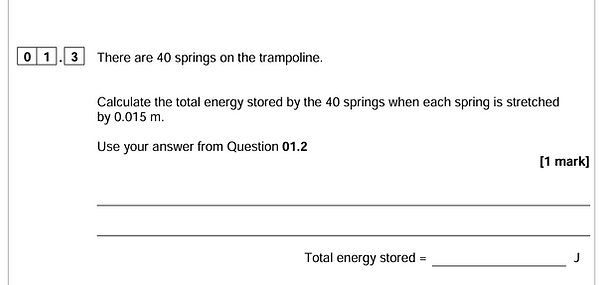
Another mark for being able to multiply. What these kind of questions are telling you is that you can get marks for areas of the syllabus that you may know little or nothing about. The question gives you the formula and the numbers to substitute into it. So, be prepared to have a go at any question of this form as they are easy pickings! Also there is nothing to lose by having a go, you do not get marks deducted for a wrong answer.
This section is adapted from material developed by Dr Robert Lucas and is related to the book High School and Undergraduate Physics Practicals, published by CRC Press.