
The internal resistance of a dry cell
Introduction
A coil spring that is firmly attached at the upper end and with a weight attached to the lower end will oscillate up and down with Simple Harmonic Motion (SHM) when given a small downward impulse.
The motion is called harmonic because of its association with the kinds of waves made by musical instruments. For example, the string of a guitar when plucked will move with SHM and this motion is then transferred to the air as sound waves. Perhaps surprisingly any wave can be represented by superimposing a number of different SHM waves. This was discovered by Jean-Baptiste-Joseph Fourier while investigating the heat equation (how heat spreads) and led to the mathematical process of Fourier analysis which can be used to discover all the harmonic components of a wave.
The objective
To investigate how the time-period of a mass-spring system varies under different tensions.
The apparatus
-
A weight cradle and set of weights;
-
A coil/helical spring;
-
Length of string;
-
Retort stand and two clamps;
-
G-clamp;
-
A metre rule;
-
A timer.
Clamp the stand to the table using the g-clamp around the base. Use the stand to support the top of the spring with a clamp. At the lower end of the spring, attach the weight cradle with a hook.
Use the second clamp, which can then be moved up and down, as a fiducial marker. The timer is used for timing the periods of the oscillations.

The variables
The weight on the spring is the independent variable. The period of the oscillations is the dependent variable.
The Physics
Consider when the spring is stretched from its natural length by a weight and not in motion so that it is in equilibrium, as shown here:

There is the force from the weight acting downwards and the force from the tension in the spring acting upwards. These are equal and opposite, and we can use Hooke’s law to find the tension, so that:
T1 = ke = mg (eq1)
Where k is the spring constant (the constant of proportionality in Hooke’s law) and e is the extension. So an expression for k is:
k = mg/e
When the spring and weight are in motion, we have the situation shown here:

The spring is stretched by an extra amount x and the force upwards is now T2 given by:
T2 = k(e + x)
So ,the net force is given by:
mg – T2 = mg – k(e + x)
Using Newton’s second law, this can be equated to the mass times the acceleration giving:
ma = mg – k(e + x)
From eq1, ke = mg, so we can simplify this equation to:
ma = -kx
This is the hallmark by which we know SHM; there is a restoring force proportional to the movement or displacement. We can rewrite the equation as:
a = -(k/m)x
Which can be compared to the normal equation for SHM, which is:
a = – ω²x
Where:
ω = √(k/m)
The period for SHM is given by:
T = 2П/ ω
Which in this case will be (we just need to put our equation for ω into this formula):
T = 2П√(m/k)
Thus, the theory of SHM tells us that the period is related to the mass and the spring constant by the formula:
T² = 4Π2m/k
Where k is the spring constant, m is the mass, and T is the period for an entire cycle (down from the midpoint, up through the midpoint, and down to the midpoint). This formula can be rearranged to find the spring constant:
k= 4Π2m/T²
If we take measurements of the period of the oscillation for a range of masses and then plot T2 against m, then k will be 4Π2 divided by the gradient.
The method
Move the lower clamp so that it marks the position of the weight cradle, as shown heere:
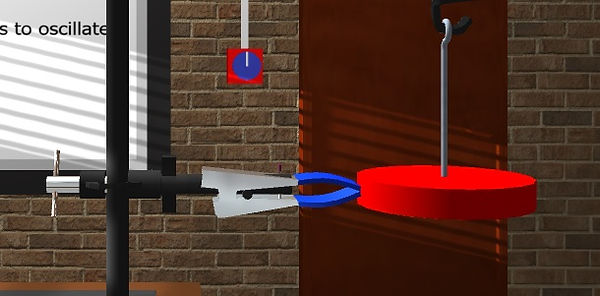
Apply a downward impulse or two to the weight carrier. The spring system will start oscillating.
Start the timer as the carrier goes past the fiducial marker. Time five oscillations. An oscillation is one complete up and down motion.
Repeat the process for all the different weights.
The Video
Watch a video for the SHM Mass-Spring e-practical here.
This shows how to use it and how to collect the data.
The Results
Note the periods for all possible weights and complete the following table:

When you have completed the table, plot a graph of T² on the Y-axis against m, the mass. This should give you a straight line, which establishes the relationship that the period squared is proportional to the tension in the spring.
Draw the best-fit line through your data points and calculate the gradient.
Use the formula given in the Physics section to calculate the spring constant.
Further Discussion
One could quite easily find the spring constant by measuring the extensions of the spring under some loads. Do this, then compare the value you obtain to one you calculated using the SHM equation for the period.
Which do you think is more accurate, and why?
This section is adapted from material developed by Dr Robert Lucas and is related to the book High School and Undergraduate Physics Practicals, published by CRC Press.