
Forces and Springs
Introduction
In this title we are going to explore how much a spring extends when we apply a force to it.
We are going to do this by looking at an e-scenario of a spring supported at its end on high, and a weight cradle attached to its lower end. We are able to change the number of weights on the cradle and measure the extension of the spring using the attached ruler.
Finally, we will look at a GCSE exam question where we can apply what we have learned.

Adding weights
The spring will oscillate a few times before it settles down and is stationary. At this point the initial position of the weight cradle can be determined by the ruler.
Weights can be added by clicking on the cradle. These increase each time up to a maximum of four added weights. Further clicking will then reduce the number of weights on the cradle. The mass of each weight is 0.5kg.
Try this now.

You will immediately observe that the spring extends when a weight is added and more significantly, the spring extends more, the more weight is added.
Hooke’s law states that the extension is proportional to the force. This can be expressed as:
F = k e
Where F is the force, e is the extension and k is known as the spring constant.
Hooke’s law doesn’t just apply to springs. It applies to anything that is elastic. A steel wire or a rubber band will also have this property. In fact, the definition of elastic is that it obeys Hooke’s law.

Confirming Hooke’s Law
We can easily confirm the law by noting the weights added and the extension it causes. In this case the weight is the independent variable, and the extension is the dependent variable.
Complete the table below.
Note that the weight is the mass x 9.81 Newtons where 9.81 is the acceleration due to gravity in metres per sec squared.
Note that we are also calculating the extension from the Position minus the initial Position giving how much the spring extended from its original length.

With the data from your completed table, plot a graph of force against extension and verify that this is a straight line which demonstrates that the extension is proportional to the force, showing that the spring is elastic.
Hooke’s law is: F = k e
So, the value of the Spring Constant, k, is simply the gradient of the line which is the change in Force divided by the change in extension. Here it is approximately: k = 18.5N/0.2m = 92.5 Nm

Beyond the elastic limit
If you carry on adding more force to a spring or a wire, a point comes where that spring or wire no longer will go back to its original length when the force is removed. In this case it has been stretched beyond its elastic limit.
This situation is easily spotted on a graph of force vs extension as the relationship will no longer be linear, i.e. the line will stop being straight and will curve as shown here.

Energy stored in the stretched wire
The energy stored in a stretched wire is given by the formula:
E = 0.5 k e²
This is identical to the work done on the wire in stretching it to this extension as, of course, it must be due to conservation of energy. You can justify the expression by noting that work done is force x distance. The force can be averaged over the entire distance e, as k 0.5e, then this needs to be multiplied by the distance which is e. This gives the above formula.
Calculate the energy stored in the wire for the largest weight you used in your experiment.
Sources of inaccuracy
-
Measuring the position on the ruler is a source of error, clearly the ruler needs to be vertical and close to the cradle. Parallax effects should be minimised by positioning your eye right in front of the scale on a level with the weight cradle. The experiment is often done with the extension measured directly against a ruler, this introduces a considerable error in measurement for a wire given that the amount of stretch is quite small. However, using a spring instead of a wire makes the extension much greater and easier to measure, but this will give the spring constant for the spring as a whole and not for the wire.
Exam style questions
AQA June 24 Foundation Paper 2

If you have any difficulty answering this, then read the section above called 'Confirming Hooke's Law'.

We've not considered safety precautions explicitly, but with all experiments consider whether goggles would help (they nearly always do).
Also stability of the apparatus, to stop things like the weights falling and causing damage. G-clamps are usually ideal for securing items, like stands, to benches, take another look at the e-scenario, how is the apparatus made secure?

Here you need to be observant, figure 13 is trying to tell you the answer.
Does the angle of the ruler matter?
Does the number of divisions on the ruler matter?
Does how close the ruler is to the weight matter?

You need to think about what the graph is representing. In the e-scenario, we measured the extension. In the question they plot the length of the spring.
What is the length of the spring before any force is added?
Does this explain the left side of the graph at force of zero?

If you have any difficulty answering this go back to the section on Beyond the Elastic Limit.

If you have any difficulty with this, then go back to the section 'Confirming Hooke's Law'.

A very simple piece of arithmetic.
Rearrange F = k e
To give you: k = F/e
And use the numbers given in the question.
AQA June 22 Foundation Paper 1

Two marks for being able to multiply, happy days!
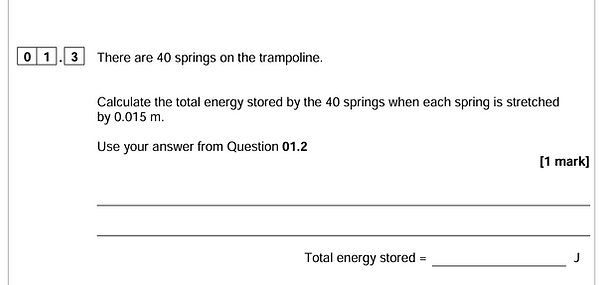
Another mark for being able to multiply. What these kind of questions are telling you is that you can get marks for areas of the syllabus that you may know little or nothing about. The question gives you the formula and the numbers to substitute into it. So, be prepared to have a go at any question of this form as they are easy pickings! Also there is nothing to lose by having a go, you do not get marks deducted for a wrong answer.

This will be obvious if you did the section on 'Confirming Hooke's Law'.

Now, two marks for being able to divide, fill your boots!