Virtual Science Ltd
Virtual Physics Lab for A' Level and beyond

Measure the value of Planck's constant using different coloured LEDs.
A set of e-practicals for Physics at A' level and beyond which include:
Newton's 2nd Law using Airtrack
This experiment uses an AirTrack to confirm Newton’s second law that force = mass times the acceleration. A pully arrangement is used to allow an adjustable weight to pull the glider along the AirTrack so that it accelerates. By measuring the time the glider takes to pass through two successive photogate timers its acceleration can be calculated. Changing the weight pulling the glider allows for a range of forces and accelerations to be observed. These values can be plotted to confirm the law.
The user has control over the air pump, the positions of the photogates and their settings, the weight pulling the glider. The user is free to move anywhere within the laboratory in order to interact with the apparatus.

Planck's Constant
Realistic 3d e-practicalthat allows the measurement of Planck's constant using coloured LEDs.
The user controls the voltage reaching the LED and can choose from a selection of different coloured LEDs. Two multimeters monitor the current and the voltage. The user is free to move anywhere within the laboratory in order to interact with the apparatus.

Velocity of AK47 shell
Realistic 3d e-practical of a virtual experiment that allows you to time a falling object to determine g on the Earth, Moon, and Mars. The apparatus consists of a tower with an electromagnet at the top that can hold a ball-bearing. A user-controlled switch controls the power to the electromagnet and starts the electronic timer. A trap at the bottom of the tower stops the timer giving the time of descent.
Young's Modulus
This experiment facilitates the measurement of Young’s modulus (a measure of the stiffness) for a thin wire. The problem with a stiffness constant, is that its value will depend on the dimensions of the wire used. If we want to be able to compare materials, we need a measure that is independent of the material’s dimensions. This requires us to use stress and strain rather than force and extension.

Conservation of Energy using an Airtrack
An experiment that shows that the kinetic energy gained by a glider on an airtrack is equal to the potential energy lost though its descent on the downward slope of the airtrack.
The user controls the raising of one end of the track, the starting position of the glider, the type and postions of the phototimers, and the air pump. The user is free to move anywhere within the laboratory in order to interact with the apparatus.
Milikan's oil drop
3d e-practical of an experiment that allows you to find the charge on an electron by examining the motion of charged polymer balls in an electric field.
The user controls the electric field: polarity and strength, the introduction of the polymer balls to the examination chamber, and can measure the separation of the electrostatic plates using a micrometer screw gauge. The user is free to move anywhere within the laboratory in order to interact with the apparatus.
Rutherfords gold foil
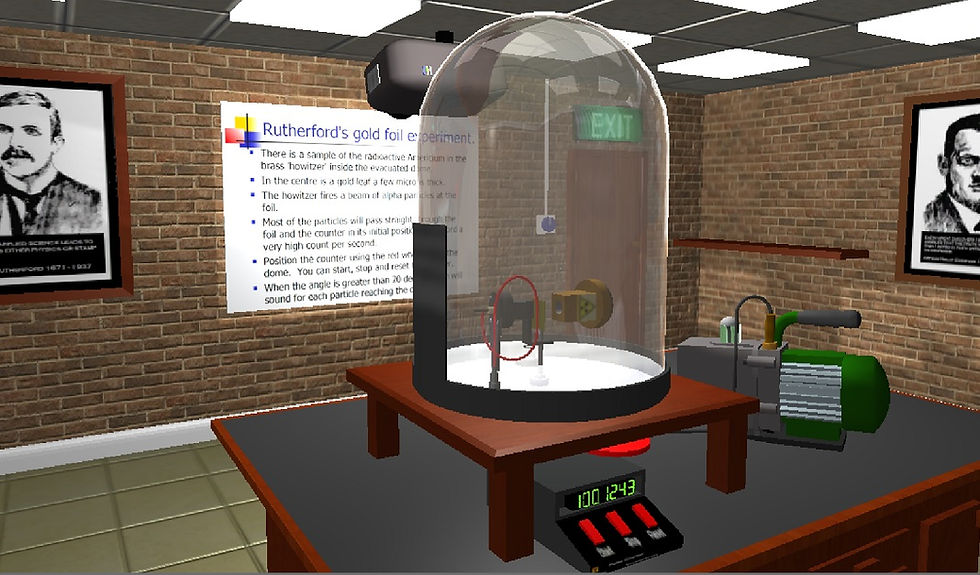
3d e-practical of an experiment that shows that the structure of an atom is consistent with having a small, positively charged nucleus. A glass evacuated dome contains an alpha particle source and a detector that can be rotated.
The user controls the rotation of the particle detector whilst monitoring the number of particles it is detecting. The user is free to move anywhere within the laboratory in order to interact with the apparatus.


Mechanical Equivalent of Heat
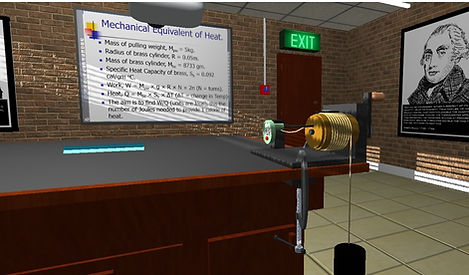
3d e-practical of an experiment that allows the equivalence of heat and mechanical energy to be determined. We generate the heat by the friction between a cord and a brass cylinder which is rotated under the user's control.
The user controls the rotation whilst monitoring the temperature of the brass cylinder. The user is free to move anywhere within the laboratory in order to interact with the apparatus.


Charles's Law
An e-practical that confirms Charles's Law that states that at constant pressure the volume of a fixed amount of a gas is proportional to the temperature.
The user controls the flow of water into the beaker that cools the water whilst monitoring the position of the oil drop and the temperature. The user is free to move anywhere within the laboratory in order to interact with the apparatus.
Magnetic Field for Coil
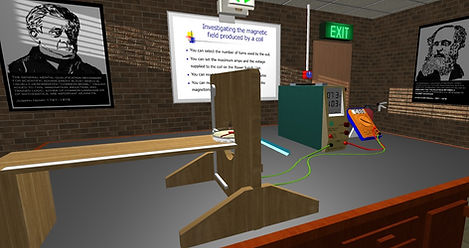
An experiment that allows the magnetic field strength of a current carrying wire to be measured. The coil can have different numbers of turns, different amounts of current can be applied, and the field can be measured at the centre and along the radial axis.
The user controls the voltage and maximum current, the number of coils of wire and the position of the magnetometer. The user is free to move anywhere within the laboratory in order to read and interact with the apparatus.
Conservation of Momentum by Airtrack
An experiment that shows that the initial momentum of two glider on an airtrack is equal to the combined momentum of both gliders after they have collided. The gliders are positioned and released so that they can collide and have their velocities measured by the timing gates.
The user controls the raising of one end of the track, the starting position of the glider, the type and postions of the phototimers, and the air pump. The user is free to move anywhere within the laboratory in order to interact with the apparatus.
Inverse Square Law for Gamma Radiation
Realistic 3d e-practical of an experiment that confirms the inverse square law for gamma radiation. All forms of radiation follow the inverse square law. That is the intensity of radiation declines as to the square of the distance from the source. In this experiment we measure the background radiation and the count rates of gamma particles hitting a detector at a range of distances. Plotting the results will verify the inverse square law.
The user can move a lead block in front of the gamma source to measure the background radiation count, and then move the detector to a range of distances from the detector and take readings of the count for a fixed period of time. TThe user is free to move anywhere within the laboratory in order to interact with the apparatus.