
Virtual Science Ltd
Virtual Physics Lab for A' Level

Show that the inverse square law applies to gamma radiation.

Investigate simple harmonic motion

Show that the inverse square law applies to gamma radiation.
A set of e-practicals for Physics at A' level which include:
Realistic virtual experiment allows students to investigate stationary waves using a mechanical wave machine. The tension in the string can be varied by altering the weight pulling on it. A plunger at one end of the string powers the first part of the wave which travels along the string. The frequency of the plunger can be changed until a stationary wave is achieved.

Diffraction of Light
Realistic 3d e-practical of a monochromatic laser and a diffraction grating to produce a diffraction pattern which enables the wavelength of the laser light to be determined. Then the number of lines of a different grating can be deduced with some careful measurements.
The user has control over the screen angle, which grating to use, the position of the grating, and switching the laser on and off. The user can position him/herself anywhere within the laboratory in order to interact/read the apparatus.

Acceleration due to Gravity
Realistic 3d simulation of a virtual experiment that allows you to time a falling object to determine g on the Earth, Moon, and Mars. The apparatus consists of a tower with an electromagnet at the top that can hold a ball-bearing. A user-controlled switch controls the power to the electromagnet and starts the electronic timer. A trap at the bottom of the tower stops the timer giving the time of descent.

Determination of Young’s Modulus
Realistic 3d e-practical of a student or teacher controlled 3d experiment that allows the determination of Young’s modulus for a thin wire.
The tension on the wire can be changed by altering the weight pulling on the wire. The wire is wrapped around a small spindle of known size that is connected to a needle. A protractor allows the angle that the axle rotates through to be measured.

Resistivity of Constantan
Realistic 3d e-practical of an experiment to measure the resistivity of constantan.
Every material that obeys Ohms law (not all materials do) has a characteristic resistivity. The resistivity is a constant for a particular substance that allows you to calculate what the resistance is in Ohms for a wire of a particular length with a particular cross-sectional area.
This experiment allows you to plot the resistance against the length of wire that the current is flowing through. Given that you can find the cross-sectional area by measuring the diameter with a micrometer you can then calculate the resistivity.
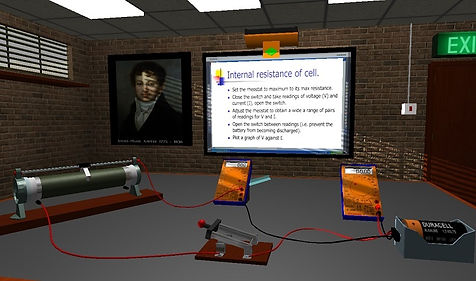
Internal Resistance
Realistic virtual experiment allows students to measure the internal resistance of a dry cell using a rheostat. The experiments starts with the user needing to complete the wiring. The position of the electrical pickup on the rheostat can be changed and the current switched. As the current draw can be significant the energy stored in the battery will drop if too much current is drawn which will degrade the results of the experiment.

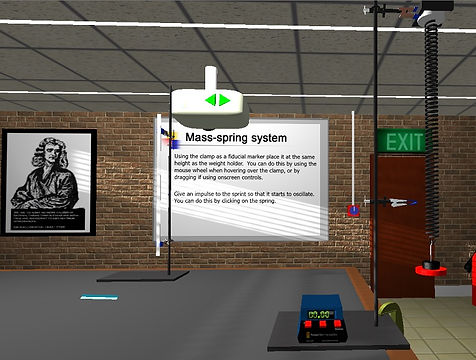
SHM using Mass-Spring
This is a teacher or student controlled, realistic 3d e-practical of an investigation into Simple Harmonic Motion (SHM) using a mass-spring system. The investigation allows us the determination of the spring constant.
The weight on the spring an be changed and impulses can be applied to the weight. A timer can be started and stopped to measure the periods of oscillation of the spring.
Boyles Law
realistic 3d e-practical of an experiment that confirms Boyle's Law: pressure times volume is a constant for a gas at constant temperature. The apparatus consists of a syringe with its plunger that allows for the pressure to be changed under control of the user and for the volume to be measured.
The user has control over the weight on the syringe plunger which changes the pressure. The user also controls a micrometer screw gauge that is used to measure the diameter of the syringe's plunger. The user is free to move anywhere within the laboratory in order to interact with the apparatus.

Capacitor Charge and Discharge
Realistic 3d e-practical of an experiment to plot the relationship between time and the voltage for a capacitor that is charging or discharging.
A capacitor is an electronic component that can store a certain amount of charge. It has a value called its capacitance measured in Farads (which is a really huge unit, we normally deal with micro Farads or even pico Farads). The circuit can be configured to either charge or discharge the capacitor, in both cases the voltage and current can be monitored.
The user has control over the power supply and the charge/discharge switch. The user is free to move anywhere within the laboratory in order to interact with the apparatus.

Magnetic Flux of a current carrying Wire
This is a teacher or student controlled, realistic 3d e-practical of an experiment to determine the field strength of a magnetic field by observing the force it exerts on a current carrying wire.
Electronic kitchen scales are used to indicate the force on the wire whilst a power supply can be controlled to vary the current in the wire.
The user has control over the power supply's voltage and the operation of the digital scales. The user is free to move anywhere within the laboratory in order to interact with the apparatus.
Magnetic Flux Linkage

Realistic 3d e-practical of a flux linkage experiment using a signal generator, search coil and oscilloscope.
This experiment establishes the relationship between the induced voltage in a coil when at various angles to another coil. It uses audio signals from a signal generator to vary the input voltage. By measuring the voltage induced in the search coilusing an oscilloscope, and varying the angle of the search coil, the relationship between the induced voltage and the angle of the search coil can be established
The user has control over the angle of the search coil, the amplitude and frequency of the signal from the signal generator, the various controls of the oscilloscope which include the amplitude sensitivity, the time frame, and the various cursor controls.

Inverse Square Law for Gamma Radiation
Realistic 3d e-practical of an experiment that confirms the inverse square law for gamma radiation. All forms of radiation follow the inverse square law. That is the intensity of radiation declines as to the square of the distance from the source. In this experiment we measure the background radiation and the count rates of gamma particles hitting a detector at a range of distances. Plotting the results will verify the inverse square law.
The user can move a lead block in front of the gamma source to measure the background radiation count, and then move the detector to a range of distances from the detector and take readings of the count for a fixed period of time. TThe user is free to move anywhere within the laboratory in order to interact with the apparatus.
