Virtual Science Ltd
Virtual Physics Lab for GCSE


This allows the radiation from various types of surface to be measured using a Leslie cube.
A set of e-practicals for Physics at GCSE level which include:
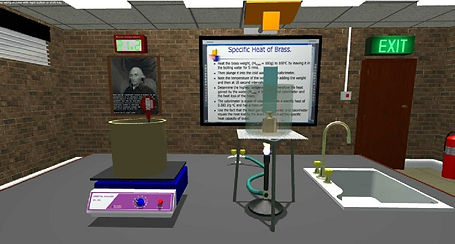
Specific Heat of Brass
This is a student or teacher controlled, realistic 3d e-practical of an experiment that allows you to measure the specific heat of brass. The specific heat of a substance is the amount of heat it can hold per unit mass. In this experiment we place a brass weight in boiling water. When the weight is in the boiling water it is gaining heat energy. After about four or five minutes it will be heated evenly to the temperature of the water.
The brass weight can then be moved to the water in the calorimeter. It will then heat the water and the calorimeter.
Knowing the specific heat of the water and calorimeter and the maximum temperature attained by them allows you to calculate the heat gained by them. This amount of heat gained must be the same as the amount of heat lost by the brass. This enables the specific heat of brass to be calculated.
Thermal Insulation
This highly realistic virtual experiment allows students to investigate the transfer of heat energy through different insulating materials at different thicknesses. Water can be heated and the temperature monitored for a variety of different insulators.
The investigator starts by lighting the Bunsen burner to heat the water. The insulating material is then chosen and placed over the beaker of water. The rate of the falling temperature can then be monitored.

Resistors in series and parallel

Realistic 3d e-practical of an experiment that allows you to investigate the combined resistance of resistors in series and parallel. Resistors impede the flow of current in a circuit. We use them in electrical and electronic circuits to control the flow of current. The higher the resistance the less current that flows. However, there are two different ways we can connect resistors together, either in series or in parallel. This experiment will allow you to investigate the combined resistance of resistors connected both ways.
The user can control picking any resistor and placing it on any free slot on the breadboard. The user can position him/herself anywhere within the laboratory in order to take readings of the voltage and current.
IV Characterstics of a Diode
Realistic 3d e-practical of a virtual experiment that allows you to plot the IV characteristics of a diode. That is, you can plot how the current changes when you change the voltage (The ‘I’ is for current and the V is for voltage). Diodes have the property that they essentially only let current flow in one direction.
The user can move the control the power supply, alter the connection of the LED, and the change the variable resistor. The user is free to move anywhere within the laboratory in order to interact with the apparatus.

IV Characteristics of a Filament Lightbulb
Realistic 3d e-practical of a virtual experiment that allows you to plot the IV characteristics of a filament lightbulb. That is, you can plot how the current changes when you change the voltage (The ‘I’ is for current and the V is for voltage). Diodes have the property that they essentially only let current flow in one direction.
The user can move the control the power supply, alter the connection of the LED, and the change the variable resistor. The user is free to move anywhere within the laboratory in order to interact with the apparatus.

Hookes law
Realistic e-practical of an experiment that allows you to verify Hooke’s Law which states that the amount a substance stretches when a force is applied to it is proportional to the force.
When we apply some force an elastic or a steel wire it will stretch and intuitively we are aware that the bigger the force the more it will stretch. We are also aware that some materials stretch more than others. What exactly is the relationship between the force and the amount something stretches for a particular material? That’s the question that we are going to answer with this experiment.

Acceleration
Realistic virtual experiment allows students to investigate acceleration due to gravity using an Airtrack. The airtrack is made to slope downwards by the user raising the track at one end. Individual timers are placed along the track and a glider is timed as it travels along the track and through each timer. The rate of acceleration is calculated from the change in how long it takes to go through each timer gate.

Speed of Waves Through Water
Realistic 3d e-practical of an experiment that measures the speed of waves in water. It uses an electromechanical plunger connected to a signal generator to create waves of a known frequency in the water. A strobe light projects an image of the waves on to a screen below the ripple tank, this makes the waves appear stationary where their wavelength can be easily measured.
The user can control the frequency of the signal generator and the frequency of the strobe light. The user is free to move anywhere within the laboratory in order to interact with the apparatus.

Refraction and Reflection of Light
Realistic 3d e-practicalof an experiment that demonstrates that different mediums bend light by different amounts and allows us to confirm Snell’s law of refraction. The reflected rays can be seen as well as the refracted ones.
The user can control the type of transparent material used, its position and orientation. The user can also control a protractor in a similar way in order to make measurements of the angle of the material used.

Infrared Radiation
Realistic 3d e-practical of an experiment that allows the comparison of the heat radiated from different surfaces using a Leslie cube and a digital thermometer.
The user can control the surface of the Leslie cube facing the thermometer and the position of the thermometer in relation to the cube. The user can position his/herself anywhere within the laboratory in order to take readings of the temperature.

Density
This realistic e-practical allows students to measure the density of a a selection of objects, some of which are irregularly shaped
All the objects can be weighted by placing them on electronic scales.
Regular shapes can be measured.
The volume of the irregularly shaped objects can be measured by displacing water in a beaker which overflows into a measuring cylinder.
